
THIS WAY UP
by Nick Floyer — July 2026
This is an account of 77 seasons sailing by Nick Floyer. Written for Strand on the Green Sailing Club, it is mainly about sailing elsewhere, with local sailing left to the end.
My father taught me to sail in the Straits of Johore, between Malaya (as it was) and Singapore. We had a 14ft RNSA dinghy, standard issue to naval warships for recreation. It was a mainly military club, races started by Very pistol; we used Malay fishing kampongs on stilts as racing marks; courses often took us over to the mangrove swamps of Singapore Island, as its shoreline then was.
Back home and at boarding school, we had several annual visits in school holidays to the Norfolk Broads. I became familiar with all the northern broads, the setting for Arthur Ransome’s ‘Coot Club’ and ‘The Big Six’, and with quanting, as in those days few boats had engines. One expedition went to the fully tidal south, sailing from Oulton Broad right up the Yare to Norwich and the Waveney to Beccles. My next school had its own sailing club on the narrow tree-lined River Lea, but I had no success sailing there.
At home we had a YW Cartop Dinghy, later renamed a Heron, which did indeed go upside down on top of the car, but took my father a lot of effort to get it there, and a trailer was a relief. We took Shearwater to Milford Haven, the Broads and the Percuil River near St Mawes in Cornwall; and as soon as I could drive, I took her from home in Somerset to the west country regattas at Torquay, Paignton, Brixham, Dartmouth and Salcombe.
While at Cambridge I coxed the college eight, but in summer vacations I taught for a short while at a sailing school at Burnham on Crouch, and for rather longer at one at Plymouth. The latter had miles of open water, numerous stopping places for picnics, and back at base a night club in the evenings. Tuition was mainly in re-rigged war-time Airborne Lifeboats. I had no formal qualification to teach and our pupils gained no certificates, it being before the days of RYA courses, but dozens of people were taught to sail.
My first job was in Manchester, and rather than buy a car straightaway, I bought an Enterprise, and cycled over to sail Liquor at the Fairfield Golf and Sailing Club: we parked our boats on the golf course, and the golfers hit their balls into our reservoir.
I next went for a one-year second degree course at LSE in London, which gave the opportunity for exhaustive team racing. I sailed for LSE, sometimes as captain, against smaller universities such as Exeter and Warwick, mainly in Fireflies – but Southampton had a fleet of Merlin Rockets – quite scary. For some reason, the sailing club at LSE had the largest social membership of any in the School – even bridge! – and its highlight was the annual trip to the Broads. We needed about five large yachts and a commodious motor cruiser that we could socialise in. Skippering these large boats after not having even sailed in one since aged 12 was quite a challenge.
After LSE, I joined BOAC, predecessor of British Airways, at Heathrow and became a Londoner. I bought a Firefly, converted it to the new Mark II design, and sailed it at Tamesis club near Kingston. However, a group of friends and I continued to join the annual LSE Broads cruise. It was then that I met Sally, a competent sailor herself, and persuaded her to come to the Broads one Easter. When we married, we found a flat in Chiswick, bought a house followed by a larger house, and became Chiswickians. We bought the prototype composite Enterprise (GRP hull, wooden decks) Espedito and sailed on the Queen Mary reservoir, but when a baby daughter came along, she so hated the creche that we gave up racing and took up family sailing.
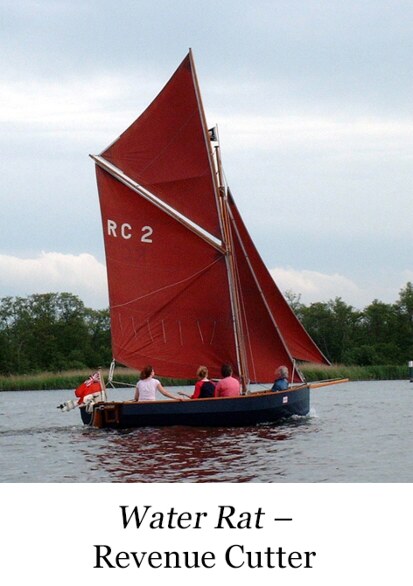
Our first dayboat was a Drascombe Scaithe, a miniature Lugger, with a very pretty 15ft canoe-stern wooden hull, a big lugsail main and tiny jib and mizzen. Our four children all had their first sail in her: our youngest twin boys aged six months, sitting at each end of their carry-cot lashed to the main thwart, on Wroxham Broad. We took Swaabie to Loch Awe, Poole Harbour, Dartmouth and among other places to France. For two years we went to the Golfe de Morbihan, and then explored further south. The island of Noirmoutier in the Vendée has a huge campsite looking back to the mainland, with drying sands between at low tide, all sheltered from the Atlantic. Once found, we returned there each summer for eight successive years, carrying all our gear in the boat.
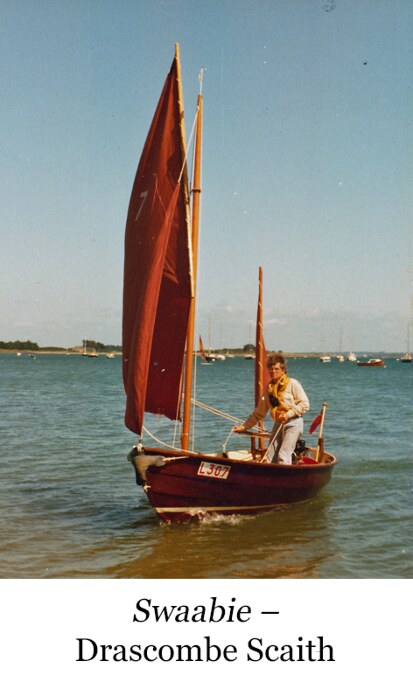
The children were now growing up in size, and Swaabie was too small. We sold her to a family who sail her still, and bought a Revenue Cutter, the second of the two ever built. Water Rat was an 18ft open boat with no decks, having jib, staysail, topsail and boom-less main. She had a narrow lightweight hull with lots of room for the six of us, and although she did not point well to windward, she was very fast on a reach. Most spring bank holidays saw us alternate between the Broads and the Lakes: the latter were of particular interest because of the Arthur Ransome connection – there is a ‘Wildcat Island’ on both Windermere and Coniston, the latter with its ‘Secret Harbour’. In 2000 we attended the founding meeting of the AR Society on Windermere; on Derwentwater we followed Squirrel Nutkin over to Owl Island. Water Rat went annually to the SGSC rally at Gins on the Beaulieu River, and crossed many times to the Isle of Wight. In the summer we trailed her to Noirmoutier with a frame tent and six bicycles stowed on board. We took her to Lough Erne in Northern Ireland, a wonderful sailing ground with the old flying boat base at Castle Archdale and hundreds of small islands to explore, some with chapels or an abbey; the children built fires on the beach and toasted marshmallows. A highlight was the 2005 Festival of the Sea at Portsmouth, and the race in the Solent organised by the Old Gaffers: setting the topsail above a reefed main in the fresh breeze, we shot round the complex course following two bermudan yachts which were in a separate race, and finished way ahead of the competition, giving the handicapper a headache because most gaff-rigged boats of our size were twice the weight.
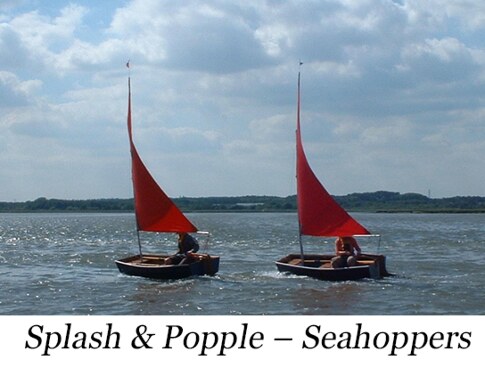
We also bought two Seahopper dinghies. Just 6ft 8in long, these fold flat for transport and easily fitted inside Water Rat, but fold out into quite efficient hull shapes – much superior to boxy Optimists, for instance. With aluminium spars and a gunter main, they sailed well for their size and were ideal trainers.
When the children were still small, we did sometimes hire a house or a mobile home, but mainly we camped. We have always had a small motor caravan, never bigger than a large car, and that has been our towing vehicle. But for longer stays on campsites we started by using a frame tent, with a playpen inside for toddlers. Later our teenagers moved out into smaller tents which they put up themselves. We are currently on our fifth campervan, and all our children, now in their forties and with their own families, have their own.
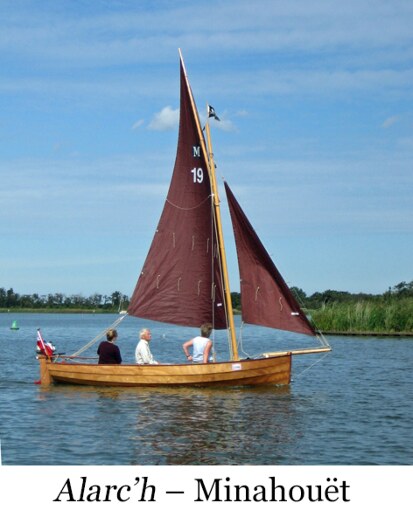
Water Rat served us well for 20 years, but when our children left home for unis and jobs, she was too large for Sally and me to handle – two pairs of jib sheets! We went to France to see a Minahouët 15ft sail-and-oar gaff sloop designed by Francis Vivier and came away having ordered Alarc’h. She was great fun, with her two pairs of sculls when required. We took her to the Sneekermere in Friesland during Sneek Week and watched hundreds of boats racing: Friesland is much like the Broads, but on ten times the scale. She went to Milford Haven for the Seahaven festival. And twice we went camping and sailing in France with a group of French Minahouët owners, most of whom had built their own boats. Alarc’h was good for two of us, but after a few years, a new challenge arose: grandchildren!
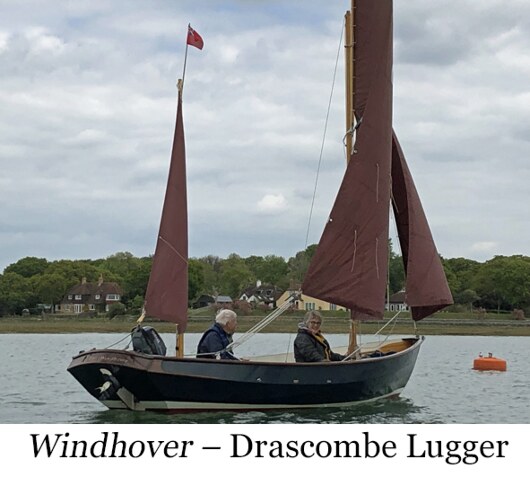
I had always thought of the larger Drascombes as under-canvassed and slow, and I was keen to continue with a wooden boat. However, I managed to find a 40-year-old wooden Lugger Windhover that proved to be in very sound condition. She was said to have been professionally restored, but I had to have most of that done again. Her sails and rigging were in such a state that no-one could have sailed her as she was: I bought new spars, sails and rigging, and so much increased the sail area. With her very heavy steel centre-plate she was still slow, but seaworthy and roomy, and proved to be an ideal people carrier. We sailed her on Windermere and in Chichester Harbour, but mostly on the Broads, for which she was not ideal but nevertheless an excellent taxi for our eight grandchildren.
From time to time Sally and I joined her brother in Greenheart, his stretched Contessa 38. He has made a number of amazing voyages in north Europe, mostly single-handed, but we sailed with him in the Cruising Club’s 2010 centenary rally from Ardmore in Scotland to Oban via Barra. Then in successive years we went from Stornoway to Orkney; from the Finnish Åland Islands to Stockholm; and around the south coast of Denmark.
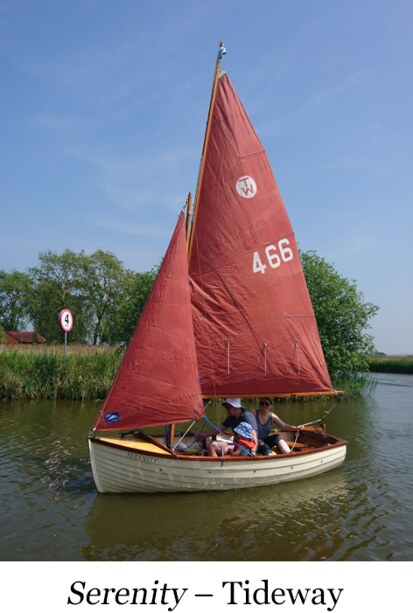
For the last few years it has mainly been family sailing in Norfolk. The campsite at Oby near Thurne mouth is the only one we know that has a slipway and direct access to the River Bure and all the northern broads. And that campsite has the great advantage of being very flexible about dates, so that we can fairly freely choose when to arrive and when to leave. All our family is boatworthy. We have a 12ft Tideway dinghy, a heavy stable boat with gunter rig, ideal as a starter boat for serious day sailing, which one daughter, spouse and children sail; our second daughter has her own Tideway for her lot. Our elder son, whose day job is running small ferries out of Falmouth, is Chair of the Cornish Maritime Trust and lead skipper of their 150-year-old St Ives Mackerel Driver: he sails Windhover when he can make it from Cornwall. Our younger son, now Commander RN, has inherited my sister’s 16ft Cornish Coble Coblestone, in which she and my late brother-in-law frequently accompanied us on various sailing holidays. Both sons are Yachtmasters.
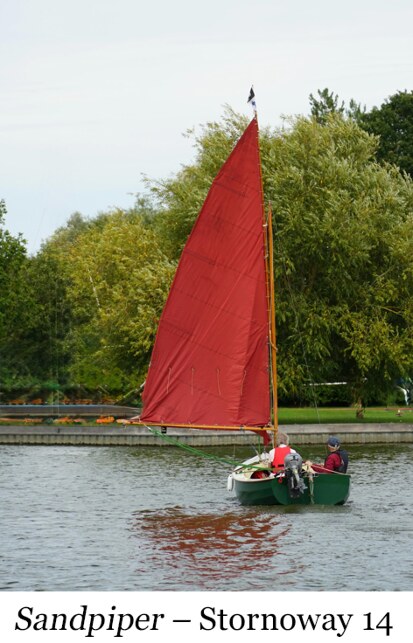
In 2025 we twice managed to get all the family together, first in Norfolk and then at the much sought after campsite at Mylor on the Fal estuary. But for the latter visit, after all the towing of boats down to Cornwall, we were faced by gale force winds for much of the few days we were there. Subsequently I was at last able to sell Windhover, which I had reluctantly decided to do a year ago, finding her now too heavy to manage, especially ashore and in her cramped winter storage space. But I had bought Sandpiper as a replacement, a 14ft Stornoway 14 design, beautifully built at home by the previous owner. We took her to an Old Gaffers rally at Oby in September, where there was a wonderful array of traditionally rigged wooden boats that you seldom see in dinghy parks.
A word about boats. All ours have been kept on trailers and stored near home. Towing with a high-roof campervan, a long bermudan mast is not possible, so we have always had gaff or gunter rig (in which the gaff is vertical). This means that all spars fit inside the boat, which makes towing easy. Another feature of most of them is that the mainsail has no boom: the Tideways are conventionally rigged and an exception, and so is the Stornoway although I have plans to change that. One advantage of a boomless sail is crew comfort: nothing to bang you on the head and no kicking strap to throttle you. But it is also a great safety measure, as easing the mainsheet in a gust instantly takes all power out of the sail, and downwind one can safely gybe in any weather. There are disadvantages, particularly the difficulty in sheeting to the quarter rather than to the centreline, and the loss of effective sail area on a run; and one hazard, in that in a very strong wind it can be hard to make any progress to windward, as one cannot feather the sail.
Our boats live on their trailers, which always need some maintenance: they need their tyres pumped in winter and wheels rotated to prevent flats. However, this makes us fully mobile. We like cruising grounds where we can make voyages and stop at some destination with a beach or landing place, eat our picnics, stretch our legs, let children run about, and sail home later. The Broads are ideal for this and provide relatively safe sailing. Windermere, Coniston and Derwentwater have islands to explore, and so does Lough Erne if you go that far. Poole Harbour offers a visit to Brownsea Island with its legendary red squirrels. The Solent involves greater distances, but has several hidden creeks: easier is to go to Newtown or up the Medina past the Ferry Inn to Newport on the Isle of Wight. Milford Haven is a huge tidal waterway, but beware of the mud. West country estuaries like the Dart and Kingsbridge in Devon and the Fal and the Helford in Cornwall are good to explore – off the Helford River is the famous ‘Frenchman’s Creek’.
For such voyages with children aboard, we have to have an outboard motor for when wind or tide have been too strong to sail against, or the wind has failed altogether. Some boats, the Drascombes in particular, have wells where the motor can be left permanently in place, afloat or ashore, but most require lifting it out and in for towing. The change from 2-stroke to heavier 4-stroke outboards, the latter being fussy about which way up they lie down, has not made it easier.
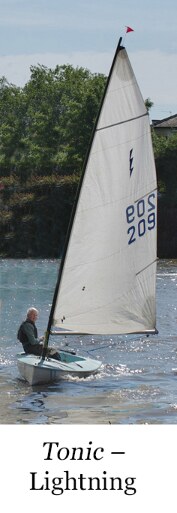
But what of sailing at Strand? We moved to Chiswick when we married and bought a house behind Strand on the Green in 1972. We joined the Sailing Club soon after, but did not sail there for a long time. I occasionally launched Swaabie at Strand End, but she was not a racing boat. Eventually I bought a National Twelve Half Nelson, but had difficulties finding a crew, Sally not being at all keen on racing or on crewing for me. Later I bought the Otter which I called Earwig: she is still with us, having been passed on to Tony Smith and becoming Airwave, and then to John Bull as Ellie. After a long break, sailing just with the family and turning up when the club went to the RSYC base at Gins once a year, I again felt the need for activity on Sunday afternoons. I weighed up two small single-handers, the Comet and the Lightning, and bought one of the former, Blue Mist, but after a year I realised that I had made the wrong choice. So I bought the Lightning Tonic, which proved ideal in many respects: a lightweight hull for easy launching; the sail goes up and down on a halyard, so no need to lift out mast and sail to roll up; a pivoting centre board, so you do not stop if you go aground; a hole in the cockpit floor so any water just drained away. She was very fast, equal to an Enterprise with a light following wind, but unstable in a fresh breeze leading to a number of capsizes. She floated so high on her side that she was quite difficult to right.
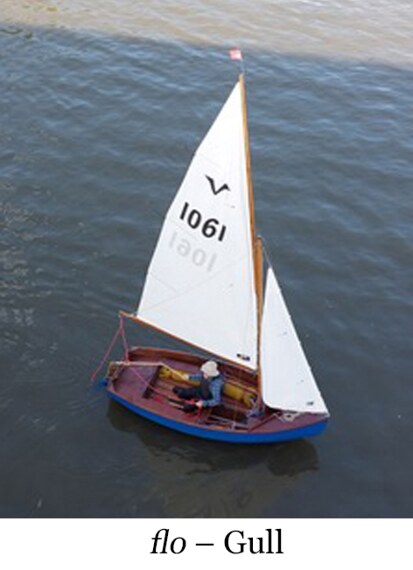
In 2021 I had an accident on the Broads, falling off one boat on to the gunwale of another, breaking four ribs and puncturing a lung. Norwich Hospital sorted me out, but I did not feel that I could continue with a tippy boat and high risk of needing recovery by the safety boat, so Tonic was sold, and I bought a Gull flo with a hole in the bottom very cheaply on Ebay and had her very expensively repaired. With her short mast and gunter rig, she can be parked on the downstream side of the railway bridge. Afloat she is stable and well-mannered, the Gull being a small Wayfarer. But she is quite heavy, and does take hours to rig.
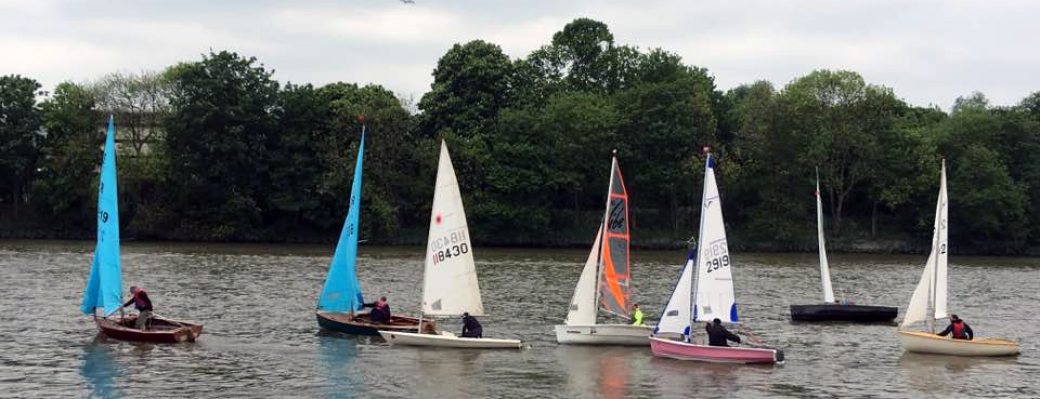
I have never had much success, sailing at Strand. I used to think that the little boats had not much chance, sailing against a flood tide, but others have proved me wrong. And races with the tide, where they have a handicap advantage, depend on when and where the tide turns, and seldom turn out favourably. There have been some successes, but my main difficulty has been the small number of races completed. Holidays and family events frequently prevent me and I am elsewhere on Sunday mornings; strong winds account for other absences, especially in 2025. But my speciality has been the long distance race. Originally to Vauxhall, once as far as the Tower, latterly to Battersea, it is a timed race starting on an ebb tide and hopefully catching the flood on the way back. I competed many times, winning sometimes, and apart from the racing it was an ideal way to get to know the river and the numerous bridges. The trick is to leave as late as you dare and hope to arrive downstream as the tide turns. But it is a gamble, because leave it too late and you do not make the turning point at all. The race was last run in 2019, bridge works and other factors having prevented it since.
Never mind the outcome, taking a boat to windward in a good wind is one of the more exciting experiences in life, and I hope I am not done yet.
Nick Floyer — July 2026