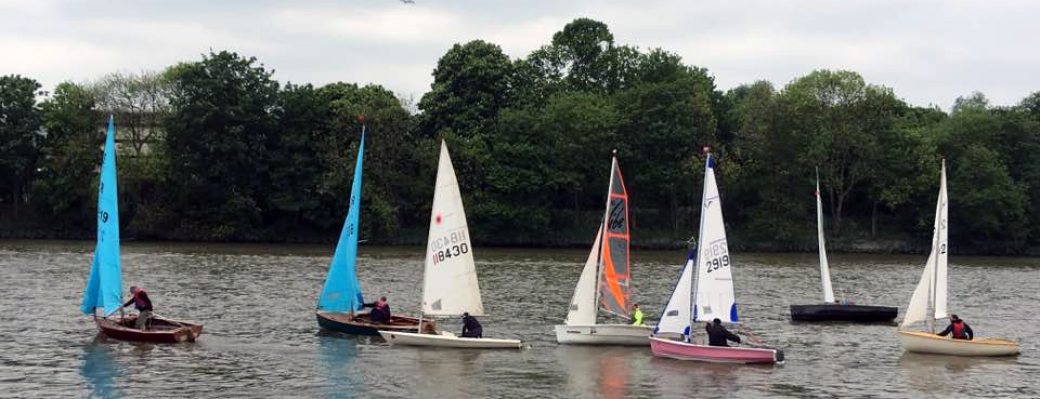
Race results 8 July 2018

Report

This points race was sailed in memory of Kurt Berger. Big Polly was sailed by Dave Berger and his mother Margaret. Other crews were: Comma – Andy R and Enoch R; Ho Ho Ho – Chris G and Mary S; Blue Angel – Lev K; Ellie – John B; Backwash – Ian N; Axolotl – Tim Y. Thanks to Chris Jones for acting as OOD while manning the safety boat.

A full report has been added under the report.

Results:

RACE REPORT: ‘C’ COURSE TO ISLEWORTH: SUNDAY 8 JULY 2018

What connects the six forward-facing 6-inch guns of HMS Belfast with SGSC and the
‘C’ course to Isleworth on a sunny and windless Sunday morning?
The answer is Kurt and Margaret Berger, 10 miles, and crucially, going backwards
under Kew Bridge.
It was Kurt who had confidently explained to Andy Ross, a newly arrived member of
the club, that quite the most delightful sailing that he and Margaret had ever enjoyed
was the ‘C’ course to Isleworth and back. Emboldened with this, your writer had
invited a prospective girl-friend at a Saturday night party to join him “on his yacht on
the Thames” for a Sunday morning sail. The following morning she actually turned
up; but rather splendidly over-dressed – and, importantly, much later than agreed.
It was a hot and windless day. The leisurely drift up to the bridge; settling in, chatting
about the night before, exchanging stories, went ever so smoothly. But approaching
Kew Bridge an apprehension that all was not well began to be felt. The arch looked
awfully low. And there was simply no way of steering the boat in the grip of the
current: Comma clattered into the roof of the bridge. The top of the mast wedged in
the brickwork. The boat slowly turned sideways with the hull braced against the flow
of the river; – and, luckily or else the mast would have snapped; over we went.
Without us, the boat released itself and we drifted out sideways under the bridge,
clinging onto the hull.
“How did you do that” asked a booming voice. It was Sir Richard Branson. He was
on a 16-person speedboat rib. He and a guy named John Evans, his Events
Director. They brought us alongside and we moored up at the pontoons at the Kew
jetty – and I began to bale the boat out; while the girlfriend immediately and very
gratefully got on board the rib.
It turned out that they were prospecting the idea John had for a limousine service
bringing 1 st Class passengers from Heathrow down to Brentford Dock – for a high
speed rib journey down to the Tower of London.
John was quite a character. He’d got himself into the SAS by climbing up the anchor
chain of HMS Belfast at night; breaking into the bridge, jumping-starting the ignition
key, opening up the Fire Control Table – and finding he had access to the optical
range finder which enabled mechanical targeting of the guns at 45 degrees with a
radius of exactly 10 miles: Kew Bridge. He got on the radio to a [no doubt extremely
surprised] telephone operator at the Ministry of Defence – and said he would launch
a barrage of 112lb shells – unless they recruited him into the SAS. Which they did.
Sufficiently dried off, and baled out – and well-lubricated with a bottle of champagne
inside us, and with two more bottles “to be stowed onboard for ballast”; together with
invitations to the limousine launch event to be held on HMS Belfast; we got back
onboard. I have to say, the girlfriend, very uncharitably, showed extreme reluctance
at the prospect of resuming the ‘C’ course, with me.

So it was, yesterday, that with Enoch on boat as crew [sadly not even remotely
pretending to be a girlfriend] we set off early – so as to get under Kew Bridge in time;
which we did, and we drew up alongside the very same Kew pontoon jetty.
Next to arrive were David Berger – and Margaret – remarkably and very
appropriately on a memorial cruise in memory of Kurt and their affection for the ‘C’
course; on a warm and balmy day for such a leisurely sail – and with an object lesson
in how to negotiate Kew Bridge.
With Chris Jones on the Safety Boat, the technique is to ensure the line-up to the
centre arch is established at least 100 metres beforehand. And for the Safety Boat to
be in reverse position with regard to the run of the current; i.e. facing the incoming
tide – with the engine idling in forward gear.
Then, with the sailing boat alongside facing forward going upstream with full sail up,
the helm can step onto the Safety Boat, heel the boat over with the side stay – and
together let the river slowly carry the pair under the bridge. Everyone can see where
they are, what they are doing; and the driver has full control. The trick is going
backward under Kew Bridge; and the right way up!
Soon we were joined by Chris Greenwood and Mary Short, then John Bull, Tim, Lev
and Ian; and we all moored somewhat insecurely alongside the houseboats; until
Chris decided everyone was impatient to go – and we set off with a start at 09.46.
With only the odd puff of wind everyone was still all together at Brentford Dock;
surprisingly all able to have a sociable chat with each other along the way. Dave,
who had been last to leave, joining us with the comment that:
“So the last shall be first, and the first last: for many be called, but few chosen”.
[Matthew 20:16 King James Version]
And that provoked Enoch to say that, in rummaging through the attic of his house in
St Albans he’d come across many fragments of some really old letters. Amazingly,
they appeared to be letters in reply to St. Paul’s letters in the New Testament. He
had written so many – but none of them seem to have ever been answered by
anyone. Were these they?
What did they say? One apparently read like this:
“My proper pukka mate Paul,
What a really great fast food pop-up event you staged last week. Those loaves and
fishes; what a brilliant concept! That Italian friend of yours, Carluccio, he’s really got
talent. Nothing fancy. Dead cheap ingredients. Sardines out of the sea. Coated in
olive oil and salt and pepper. Then rolled in your own Paul’s bakery breadcrumbs,
sun-dried leftovers from yesterday’s loaf baking, sprinkled with oregano, flash-fried
on the embers of the seashore bonfire; and when they’re golden and crispy – they’re
done! A sprinkle of lemon juice and you’ve got something not just to feed the 5,000
but, think big, the whole Mediterranean! If you’re expanding the franchise you need
to ditch Paul & Antonio; it’s too gay. If you’re taking it to France, go for something
that’s ready to eat; how does Prêt a Manger sound in French? Yours, Jamie.

As the Safety Boat toddled along behind the fleet there was some discussion on
whether we’d actually get to a buoy up at Isleworth, or to drop it early? Eventually it
was thought the line of the concrete wall by the church would do. The wind was
giving no-one any particular advantage. And so the whole fleet converged, almost
simultaneously, on the buoy.
It appeared that Ian was the first round – evidenced in his whoop of pleasure, with a
scramble and some bumping as everyone else jostled about it.
Except Tim. It was as if his boat had a bloodhounds’ instinct for its normal
destination of the bar at the London Apprentice – and it headed straight on up there
for a pint, despite Tim’s urgent tiller-waggling to tell it that was totally wrong.
Heading into the North bank and the easier current, everyone got stuck on the still-
incoming tide with a minimal wind. Easing out to gain some water, only to be swept
back – then easing out again; only for the sequence to be repeated.
Chris in the lead, and then Dave, tried out the opposite bank. But the effort to get
there produced no obvious difference in distance gained.
Ian found his lead was completely lost as he got caught in an eddy by the bank and
then found himself enshrouded in long lines of willow tree branches. His frustration
grew noticeably in strength and temper even to the point where it was thought he
might very volubly suddenly employ the crudely horrible scatological language of the
ex-Foreign Secretary; much like his reputation now is in: “polishing a tree”. But no.
It so happens that a photograph was taken of this moment. A picture was taken by
someone on the Kew riverbank of the line of three boats against the Syon Park
woodland; John Bull’s white sail, Andy and Enoch’s blue sail, Ian’s translucent sail –
which was the picture shown on BBC 1 throughout the evening on the day’s weather
forecast to illustrate the calm and peaceful river side setting of the hottest day of the
year. Little did the picture-taker – or, of course, the millions watching, actually know!
Rather like a long line of dough being rolled out into a baguette, and separated into
batons to be baked in the oven, so the fleet gradually dispersed as the tide eased
and the wind picked up.
And another fragment of the letters to St Paul came to mind:
“Dear Paul,
Good to hear about your plan to go to Rome. Now then, regarding that fiasco in the
temple last month when your friend Jesus tipped over all the money-changers’ tables
in the crypt, which I had to sort out. It caused all sorts of trouble; runs on the
currencies with them spilling everywhere. Thing is; these guys are making a fortune
on the margins. What we need is a simpler system; something I’m calling a common
market currency. Do away with all this ridiculous waste of precious metal. We need
a standard for everyone to make money on. The Romans won’t like it. They always
want to monopolise everything. And the Greeks won’t even have a bath unless they
can get the drugs and the illegal migrant money without paying any tax. What we

need is your clever idea of a temple crypt currency: a crypto-currency for short.
Look, I’m sending you a bag-load of all these old currency coins I swept up from the
floor on the next ship to Rome. I want to buy into your faith idea. I want you to buy a
really big building in Rome; by all means call it a church if you wish [I think cathedral
sounds better] – and stick your name above the door. On the dome is even better
Money is all about faith. I met this Anglo fellow the other day; said he was from the
City of London [never heard of it] – and, of course, he didn’t speak any Arabic. But
what he did say was “My word is my bond”. I like that! I think that’s good enough to
trade with him; you could even set up a ‘bond market’ – with good faith on all sides,
of course. If you find the right building I think we can go global with this: “faith in
banking idea”; might even call it Yes-we-can / Bankican / Vatican? I’ll make you
Managing Director. How does that work for you? Let me know what you think when
you get to Rome. Do please look after my money and send me regular accounts.
Yours Jacob
As the fleet neared the finishing line there still wasn’t much in it between everyone.
Chris acting as both OOD and Safety Boat operator blew the whistle as they crossed
the line and came round to moor in together alongside the Kew pontoon barges.
One by one, the same reverse guidance technique of pairing a forward-facing sailing
boat with an up-stream facing Safety Boat enabled the passage under the bridge,
drifting very slowly with a high tide still flowing quickly, to be completed safely.
Comma dropped her sails completely, which were scarcely needed anyway in the
faint wind – and glided under this potentially traumatic bridge, and paddled home.
Meanwhile Enoch recalled another fragment found amongst the long-lost replies to
St Paul; though it probably will need Mary Short, just returned from a month-long
Ramadan experience in Jordan, to provide the exactly right Arabic translation. But it
seemed to read something like this:
“Hi there Paul,
Great to see you at the bunga-bunga boat party last weekend. Wasn’t it amazing!
Those girls from Ephesus are absolute stunners aren’t they? No wonder you were so
shocked: seeing something you shouldn’t have! That’s my kind of party! And I really
liked your expression: “God blind me!” I’m going to use it to publicize the next event.
I’ll add some pretty graphic descriptions on page three to go with the headline: “Cor
blimey!” Really hope you can come. I’m hoping a new guy I’ve heard of called
Donald will show up too; sounds like he’s a bit of a party animal too, just like you! It’s
an open-shorts invitation. No need for another long letter. Just drop me a note if
you’re coming to say: “Me Too!”
Cheers Silvio
And so the boats were safely tucked up tight in their beds, though without tea, or
champagne, after a memorable – and a memorial – ‘C’ course.
© Andy Ross


Race results, 01 July 2018 – Long Distance

Results:

            Elapsed Corrected
Helm    Class  PN   Time   Time  Position
 
Tim Y   Gull  1363  3:57   2:54   1st
Alex P  14ft  1170  3:41   3:09   2nd
Lev K   Ent   1091  4:33   4:10   3rd*
 
*technically disqualified, having not quite reached Battersea Rly Br

RACE REPORT: Long Distance. 1 July 2018

“And now the shipping forecast for inshore waters:
Gibraltar Point to North Foreland: Another sweltering hot and steamy day, folks, so
go easy on the cold lagers, at least until the Croatia v Denmark kick-off at 7.00pm
when you can crack open the Carlsberg….and especially leave plenty of room for
Stand on the Green sailors zigzagging around on the Thames in the sunshine during
another baking hot day; everyone knows they’re totally mad, so leave them to it.”
Lev was first to arrive. Keen to go, he’d been uncovering his boat practically at dawn.
Then Alex, limbering up in super zany blue and white Hawaiian shorts and crocs.
Finally Tim, cycling in with a flourish and tales of having been up at 4.00am the day
before for a whole day sailing on a tug from Brentford to Greenwich and back. No
sign of Michael who had said he’d sail. John Bull turned up, as did James, and they
kindly assisted everyone getting ready; despite already sweating in the heat.
Boats were trundled down across a sticky brown foreshore; the river had had no
fresh rain in it for three weeks and so the agricultural run-off of farming fertiliser from
farmland up-stream had been sinking undiluted into ditches and small streams;
loading the foreshore with nutrients and producing mats of algal sludge.
The odd puff of wind was just that. James was quizzed about the timing of a start:
‘Some time after 10.00am – so as to get to Battersea railway bridge just on the turn
of the tide – about 12.00pm.’ But the general opinion was that around 10.15am
would be about right. So Tim set off; and meandered around aimlessly in no wind
until he drifted listlessly under the railway bridge and was recorded by the OOD as
having officially started at 10.09am.
Alex followed at 10.19. And finally Lev, sailing his newly-rigged and restored
Enterprise single-handed, passed under the bridge at 10.21am.
There was a bit of a breeze; oddly from the North, but enough to send everyone
down to Chiswick steps which Tim reached at 10.25, Alex at 10.35 and Lev at 10.45;
all at the same 10-minute interval from the start.
But, in a sign of things to come, a sudden flip of the wind caught Lev sideways – and
he was at 60 degrees for a dramatic moment. Calm was restored and he drifted
under Chiswick Bridge into a pool of plain, silver-smooth water.
By Barnes railway bridge Tim was out of sight, but Alex was easing his way round
towards Corney Reach while Lev cleared the bridge at 11.05.
The majestic long line of twenty tall black poplars at Corney Reach arched over their
tops; there was a bit of wind up there. And by Pissarro’s [now sadly defunct, with its
brand name letters askew] a sprightly new breeze from the East was encouraging
the thought of better sailing.
The sign post at the end of Chiswick Ait indicating the headroom at Hammersmith
Bridge showed there was 6m clearance; easily enough for us.

At Corinthians, Tim was still out of sight but Alex passed the LCSC signal box at
11.07 and Lev at 11.17 – still exactly a 10 minute gap between them. Oddly, there
was not a single other boat to be seen anywhere on the river; no rowers, sailors or
motor boats. Where was everyone? Unbuttoning lagers?
Under Hammersmith Bridge and along to the Harrods Furniture Depository [or the
Oligarch’s Suppository, as it’s unkindly known] all three boats were back in sight; Tim
down by Fulham Football Club, Alex at SBSC – while Lev was plugging up the rear,
so to speak.
The time between the three began to tighten. Tim passed under Putney Bridge at
11.40 followed by Alex at 11.45 – and Lev at 11.50; each now at five minute
intervals. Was Tim slowing down? Or Lev catching up – or both? The wind was
freshening to a steady Easterly.
The whole character of the River Thames changes at Putney bridge.
To start with, it has 16 CCTV cameras on it; covering all arches, both sides.
Suddenly the GDP of London becomes much more obvious. The buildings are
bigger and make important statements about their presence. Tiered and set-back,
they rise up in geological layers; stratification of wealth and ownership, overlooking
Wandsworth Park and Hurlingham Gardens.
And with the architectural grandeur came an even stronger hot wind. Stiffening
breezes from the East were making waves – and arriving in unexpectedly big gusts.
It was at Wandsworth Bridge that the dramatic action began.
Tim passed through exactly on 12.00 noon. Alex was through at 12.04.
But Lev, still upstream and right beside the Wandle river as it tried its best to add
some fresh water to the turgid Thames, spun around in a gust and heeled over into a
capsize. Thus he found himself carried under and through the bridge; fortunately
without any traffic about. Easing himself onboard he found that in the stiff wind it was
just about possible to make sufficient speed for the self-balers to begin to gurgle
away – and he resumed the race – though still noticeably low in the water.
Battersea Bridge was then in sight!
Rather as the Hubble telescope observes the passing of exoplanets across a distant
sun, seen by the dimming of the light they cause, so the sails of Tim, and then Alex,
darkened from white to grey in the shadow of the bridge – and then lightened again –
only to darken once more, and return to white as they re-emerged, having turned
around and come back. Tim went dark at 12.06 – and returned to white at 12.08.
Alex went dark at 12.20 – and returned to white at 12.21.
Lev, meanwhile, was held in a slowly becalming arena of water around Plantation
Wharf; beside the stacks of apartments like ocean liners, even with white balconies
looking like empty lifeboats strung alongside. The reed beds on the embankment
were being gently ruffled; but without much to indicate which way to bend in the light
and fickle wind.

Stories of Lev’s capsize were exchanged as Tim and Alex passed by. But now the
real race was on to see if Lev could get to the bridge in the face of the turning tide.
Firstly he attacked the south bank. Tacking to and fro in the gentler tide by the side
of the Battersea heliport he inched his way forward, only to find that the shadow of
the buildings was blocking the little wind. So he went into the mid-channel. Only to
find the ‘Cockney Sparrow’ was jauntily steaming down river towards him, with no
intention of giving way to the intruder on his [her?] territory. Back to the south bank.
From 100m back the OOD observed, firstly, the Overground train going north to
Willesden. And then a hugely-long freight train went the other way to Clapham
Junction. After a while, another Overground train followed to Clapham. The Sunday
timetable is a relatively relaxed affair. How many more would come and go before
Lev got to the bridge?
Significantly, the level of fuel in the tank was hovering down to minimal. And it was
with great relief that the OOD thanked John Bull who, despite the OOD having
assured him that he was quite certain there was more than enough fuel for the
journey had, nonetheless, wise virgin keeper of the oil lamp that he proved to be,
tucked in a small can in reserve. It was glugged in.
There was then a difficult conundrum for the OOD to ponder: whether to go and ask
Lev what he intended to do? On the one hand, Tim and Alex had long gone and
were probably sailing happily together. The obvious priority was to stay with Lev.
But in asking what he wanted to do would be rather like asking Schrodinger’s cat if
it’s alive or dead – the question itself would make the difference. And it was clear
that Lev was engaged in a Nietzschean existential battle; overcoming nihilism with
insight into the meaning of life though positive engagement with difficulty as a
personal triumph of the will. He crossed the river again; just 20m from the bridge.
The Battersea Heliport windsock hung like an elephant’s trunk.
But what was that noise: a clattering in the distance – and a helicopter coming into
land! Would the downdraft blow him through the bridge? Alas no. And five minutes
later, it took off again – doing its best to send a flurry of wind his way. But there was
no way against the water.
At 13.25 the game was over for Lev. Human willpower cannot contradict nature.
Turning into the main channel he picked up the current and shot away.
But no sooner than Wandsworth bridge had come in sight when a big gust of
following wind spun Lev round – and into another capsize: No. 2. This time, the OOD
felt it was appropriate to ask if he’d had enough? No way! He was baling out and
baling out – and carrying on!
And then capsize No. 3, at Putney road bridge – with, no doubt, the operator of the
16 CCTV cameras watching the drama.
Capsize No. 4 was at Fulham football stadium. And it was the same syndrome. Not
helped with jugloads of water sloshing around in the bowels of the boat, it seemed

that as the wind bore down on the mainsail it couldn’t accelerate the sluggish boat
speed; so the centreboard acted like a plane wing lifting and tilting further and faster.
Capsize No 5 was at The Dove.
By this time Lev was sailing in a well-filled bathtub with loads of warm water and
plenty of soapy suds [Sustainable Urban Drainage System] for company, but not
really something to relax into and enjoy. There was, in addition, the distinct smell of
rotting seaweed in the air – a fragrant reminder that the incoming tide was bringing
back up the presence of the sea.
Capsize No 6 was at Corney Reach.
This time, the event was watched by the passengers on the packed-out Princess
Rose, going upriver, The captain decided not to overtake him and hooted four times
– and all the passengers applauded as Lev eased himself back onboard like a seal
hauling itself onto a sandbank.
Lev eventually crossed the finishing line at the railway bridge at 14.54; after some 4
hours and 33 minutes of gruelling sailing in broiling heat.
Alex [who had finished at 14.00] had taken 3 hours 41 minutes.
Tim [who had finished at 14.06] had taken 3 hours 57 minutes.
Alex and Tim had very kindly waited for everyone to return and it was much
appreciated that they helped to bring all the boats and gear ashore – and to share
their stories of the Long Distance Race.
Andy Ross
OOD
1 July 2018

Race results 24 June 2018

Race Report

This was a sunny Sunday morning race, with a good turnout of eight boats. The light, fickle and fading wind was just sufficient, most of the time, to enable headway against the flood tide – it was three days before full moon and top of springs, and with no recent rainwater coming down the river. This report is based on an interpretation of Inna’s immaculate race sheet.

James (Ent) raced ahead in his usual style. Apart from Tim (Gull), who retired after three laps, and Andy (Ent) who completed five, it was close race over the first six laps for the other five boats. At that point, James was close behind finishing his eighth lap, and the whistle was blown to finish the race, leaving the others to complete their seventh. This took Ian (Vibe) and David (Solo) nearly quarter of an hour, Rob (Laser) rather longer, and John (Laser) and Alex (14ft) in a dead heat longer still.

Many thanks to Lev and Inna, who between them organised the race, manned the safety boat, and recorded the results.

Nick Floyer, the man who was not there

Some correction to the report of the man who was not there:

David was in the safety boat. (Thank you!)
David Berger was racing and testing Tim’s solo.
Andy was the first to get to first buoy but lost to James at the second down the river one.
Lev actually was crewing for James.
Most boat were got stuck close to OOD trying to sail down the river.
The rumour says Andy did not wear life jacket. 🙂

Race Results

Race Results, 20 June 2018

Race Report

Arriving at the club, the wind was extremely gusty and it was immediately clear that it was more a case of when, rather than if, one the hopefuls would capsize. The sailors knew as much, hesitating on the bank, before finally steeling themselves for the ride of their lives.
Acting Master of Sums Nick Floyer, calculating that his odd of capsizing were 10-1 on, retired his Lightning, recording an official DNS (did not start).  The popcorn had barely been ordered when less than a minute after the starting gun fired, Lev was down. He immediately righted the boat to a cheer from the bank, but having taken on a skinful of water, she capsized once more, retiring her brave sailor.
Tim took the first lap by 14 seconds on Andy & Enoch, however, by the second the positions had changed, with Andy’s Ent leading Tim’s Gull by nearly a minute.  Tim fought on, but the gap widened, and by the third and final lap, Andy and Enoch were ahead by a minute and a quarter – in some of the most exhillariting sailing Andy’s Ent has seen for a while.
Thanks to James for much-needed safety boat skills, especially without boat hook or oars!
Sam Shemtob OOD

Race Results, 10 June 2018

A lengthy, drifting, gruelling, frustrating race on a windless Sunny Sunday at SGSC.

The predicted Met forecast for Kew was light winds from the North East. A “B” course was programmed, however, the OD considered the possibility of a change to an “A” course due to the light wind making it difficult to clear the Pier, but after discussion with the helms and the site of ripples off the Pier, a “B” it was.

Six dinghies were prepared to endure the light and fickle conditions. The course was set by Tim Young and Dave Jones in the safety boat with the usual buoy positions, except for the downstream buoy being moved upstream to shorten the course.

Apart from Andy and Stephen in Comma who were having a problem making the start line against the tide by the Railway Bridge, all the other dinghies had good starts. Rob (Phoebe) rounded the Pier after 6 mins followed by Chris (Ho Ho Ho).

Lev (Blue Angel) and Alex (Phoenix) rounded the Pier after 17 mins. Tim Wellborn and his son Rob (Enterprise) and Andy and Stephen (Comma) were struggling with the very light and variable wind and the tide conditions. They tried inshore to avoid the tide but little wind, mid-stream to get the wind and sometimes getting a puff of wind to send them towards the Pier only to be washed back with the tide. Most frustrating for them. The others who had rounded the Pier were stalling by the rowing club and drifting. It was decided to shorten the course again by bringing the downstream buoy nearer the rowing club.

Chris (Ho Ho Ho) was sailing his enterprise solo and brilliantly. He completed his first lap after 32.25 mins. Lev, Rob and Alex followed with Tim and Andy still attempting to clear the Pier. It was debatable whether a second lap could be achieved with the one-hour race closing. However, the tide was easing. Amazingly all the dinghies began to make the tide and within a few minutes all had rounded the Pier, some for the first time. HOORAY.

Now all the dinghies were together, tacking past the rowing club and rounding the downstream buoy with little trouble. Positions were changing and Alex in Phoenix was breaking free. He rounded the final buoy ahead of the fleet and squeezed over the finishing line 5 seconds ahead of Lev. All the other dinghies were very close behind with only approx. 2 minutes between them at the line. Comma and Ixion completing 1 lap and the rest 2 laps.

Many thanks to Tim and Dave in the safety boat, sorry about the soaking Dave.

Race Results, 27 May 2018

Race Report 27 may 2018

The only two sailors to turn up for this windless Isleworth race were so underwhelmed by the conditions that the whole thing was very nearly not bothered with.
Eventually Lev’s enthusiasm prevailed and two Enterprises were launched, Rob C collecting Lucy as crew on the way.

Through the bridge there was no question of sailing against the current so it was a hang-on start , managed by Michael Somerville from the safety boat , which was operated by Tim and Dave.

In the total absence of any wind to speak of, Rob and Lucy seemed to drift with the tide slightly faster than Lev – perhaps the extra weight of a 2 person crew made their boat catch the water better than Lev’s single handed displacement- but anyway by Syon they had a 50 yard lead.
Puffs of the lightest wind then materialised occasionally, and by skilful use of these Lev managed to make up all the ground he had lost . The two boats rounded the mark at Isleworth together. With a strong flood still running the two boats made for the still water near the quay where they waited for the turn- Rob anchored, and Lev somehow managing to keep sailing against the tide in zero wind and eventually ghosted decisively into the lead.
A dramatic snails pace battle then developed – initially in the tide dead spot along the quay and in front of the pink house using occasional puffs that came randomly from ahead, astern and abeam.  As the tide eventually slackened enough for the boats to be able to use more of the river they started to make progress, sailing in the puffs and drifting in the calms as far as the Brentford dock housing, neck and neck, with the lead changing continually.

Here Rob made a lucky choice and took the Brentford bank where he found a tiny but useful breeze and a strengthening tide. Lev, on the Kew bank, had neither.
Rob’s luck held as he rounded the bend to Kew Bridge where the finish line swept up past him while he happened to be 50 yards ahead of Lev.

The total time taken to get to Isleworth and back was something like 2 hours. Is this a record?

with SKB at Salcombe, 20 May 2018

SGSC AND BERLIN SKB AT SALCOMBE 2018 [See photos attached]

Sunshine glinted and sparkled off the multi-layered coats of varnish of Rob Adam’s immaculately restored boat ANCIENT CITY – recovered as a sunken wreck in the mud of the river Thames at Hammersmith and now gracing the waters at Salcombe.

SGSC and SKB sailors gathered by it on the Normandy Ferry pontoon, site of the American Army embarkation for D-Day, ready for an inward-bound invasion of the upper reaches of the Salcombe Estuary to Frogmore Creek – at the head of which lay the prospect of a good dinner for everyone at The Globe Inn.

Seconded into the fleet was Rob’s friend [………] whose similar open motor boat could also easily carry 10 people. As a blue-sky sunset dipped into the West behind Salcombe town with its crowds of Bretton-shirted and salmon-pink-trousered sailors, our very own double-breasted fleet chugged happily off into the estuary heading North up this long seawater estuary, formed in the Ice Age and known as an sea inlet ‘ria’ for its lack of freshwater river inflow – brilliantly lit on our way by the low-slanted glittering light on the water of the setting sun.

Threading our way through the resident and visiting yacht moorings, and then between the narrows of Snapes Point and Scoble Reef, suddenly the vista opened up to reveal the glory of the South Devon Area of Outstanding Natural Beauty.

ANOB’s are Britain’s best landscapes. There are 46 of them, designated by government and protected by law. Each one has its own special character. South Devon AONB covers 60 miles of coastline, estuaries and countryside between Plymouth and Torbay consisting of extensive coastal plateaux (areas of elevated, relatively level land) with great panoramic views along the coastline with dramatic cliffs interrupted by inlet combes [small valleys with steep dense woods in them], extending up to two kilometres inland. 

Following the fairway buoys we passed by stands of these woodlands, packed with oak and willow trees growing right down to the seashore; remarkably also with the occasional tall English Elm – sole survivors of the ravaging of Dutch Elm Disease. There were no big plantations or commercial woods here; all were too small for use except perhaps for local farmers’ handsaw milling for fencing and firewood, and with no disruption allowed by any intrusive modern house-building in these very ancient woods. The steep sides mean they are virtually inaccessible; and so they remain as an important haven for wildlife. As if on cue to confirm this, and to note our presence passing by his territory, the hoot of an owl echoed across the still water.  

The view opened up into the broad inner estuary. Suddenly the landscape looked different. Because the soils of the area are so fertile and the plateau land is so easy to run machinery across, these broad fields have been stripped of the high hedges that otherwise line the steep and twisting lanes of South Devon.  

Hedges are one of the really special things about this area. There are still over 2,500 miles (4,000km) of them in the AONB. They give the land its patchwork pattern. Some of the hedges were landownership boundaries originating in the Bronze Age, around 4,000 years ago. Many more were built in the Middle Ages, over 500 years ago. The most recent were built when open areas of cliff top were divided up into field parcels in the 19th Century; and then acquired and inherited by family estate landowners. But then the EU Common Agriculture Policy [CAP] came along.

Big land ownership means big money in big subsidies for big farming production. And that meant ripping out all these uneconomic hedges and planting mono-culture commodity crops.

This impact could be obviously seen in the dark green/black tracks left by the tractors with 36’-wide boom-sprayers of fertilisers and weedkillers and insecticides being spread over fields of viridian-green crops. And these tractor tracks were running only up and down the fields; not across and back along the contour lines, which would be less efficient and more expensive. It means that whenever it rains the run-off is chemical pollution that runs straight down into the estuary, taking the top soil with it; with only the ancient hedges and the bank of trees on the waters’ edge to stop it.      

80% of the wildlife of Britain has been lost in the last 30 years because of this. But it is now likely that post-Brexit, ex-CAP, a New Agriculture Bill based on the 25 Year Environment Plan will at last put a stop to this terrible loss and the government will pay farmers instead to protect and enhance the remaining biodiversity and thereby provide the sustainable ecosystem services on which the real economy of the area depends, such as tourists coming to see and enjoy the natural glories of nature in the AONB.

We turned up into Frogmore Creek. With the incoming tide we were accompanied by a golden brown froth on the waters’ surface, which could easily be mistaken for pollution; but it is, in fact, diatoms; phytoplankton which live in the water column and on the surface mud in estuaries. These tiny plants use sunlight and nutrients in the water and the mud to grow and to reproduce. On an incoming tide multitudes of these diatoms are lifted from the surface of the mud and form this golden brown frothy ‘scum’ on the surface of the water, providing a nutritious meal for grey mullet and crabs as they follow the water in and come out to feed – and for us to feed on them, if we wish!

We looked out for kingfishers, otters and little egrets along the shoreline while cormorants contoured up the creek beside us – and swifts overhead screamed and swirled and spun round and targeted aerial insects.

It was the Royal Wedding Day! And Frogmore House was the Grade 1 listed glamorous venue for Prince Harry and Meghan Markle’s post-wedding party!

Frogmore House has attracted Monarchs and Lords and Counts for the grandest of English-German royal parties since the reign of George III and his equally glamorous German wife, Queen Sophia Charlotte of Mecklenburg-Strelitz – who served as the first Queen of a United Kingdom of Great Britain and Ireland until her death in 1818. But that Frogmore is set in the immaculate lawns of Windsor Great Park.

Our English-German post-wedding Frogmore party venue was at the tiny head of a watery cul-de-sac matted with wavy reeds and wading birds pecking away in the mudflats and amongst the seaweed on the encroaching tide.

And as if in our own Royal Party procession, after leaving our boats, and in a long and single crocodile line, we carefully crossed, one-by-one, with our wedding-trains lifted up, along a line of slippery stepping stones laid across the upper reaches of the salt marsh to find The Global Inn of Frogmore.  

It’s a small and snug 18th century traditional Devon pub; with local limestone kiln-dried and whitewash-painted outside walls and, inside, low-slung roof beams and bare stone floors with nooks and crannies with benches and wood-burning fireplaces – and a perfectly-sized small party dining room at the back with two big refectory tables for us all to cram around.  

Still stuffed with the enormous doorstep-sized crab sandwiches marvellously organised by Heather that we had all eaten at lunchtime on the sunny terrace of the Salcombe Yacht Club after the Royal Wedding, there was some thought about the great array of food on the menu: steaks and seafood, salmon and pigeon – and also the question of what to drink.

While pondering this and plumping – of course – for local Devon cider, Tim found there was a drawer under the table which opened up to reveal sheaths of hand-written poems!  It seems as though a tradition had developed by parties previously gathered in this room to write and leave poems about the occasion. Some were really personal and intimate and [very] explicit, while others ranged from the philosophical about the rain and the weather, while the best were hilariously nautical and bawdy. Obviously, something had to be written by us!

The SGSC version was composed by Andy Ross:

“The Germans from Berlin are here

And they’re not just drinking the beer.

The sailors from the Stand

Have made their stand;

And Devon cider is something to cheer!”


And, in response, an SKB version was composed by Klaus:

The good times have passed so quickly,

We hope will not have to worry about a Visa,

When in two year’s time,

We will once again travel,

To enjoy over here,

Cider and Beer,

After much kerfuffle at the end of the meal over the apportionment of how the bill was split between the tables all was resolved and we emerged into a vast and starlit night. If only Brexit negotiations were so easy!

In fact, though, there is a strange money background to the story; which affected us. It’s indeed about the real bill. There are actually two currencies in the AONB.

There is the Pound Sterling. This is the currency of the robber barons of the area.

They are the owners of the great landed estates living off the CAP subsidies at the expense of local smallholding farmers; most of whom are close to poverty. And it is the currency of the speculators who invest in the range of huge and empty properties high on the hillsides of Salcombe: tombstones of international property portfolios owned by oligarchs; be they Arabs or Russians – international trophy properties increasingly now being traded into by the Chinese. And it is also the currency of all the pubs and shops in Salcombe who charge London prices to fleece the tourists in a seasonal earning spasm that sees the town’s population rise from a residential 1,700 to a transient 23,000 during the summer. Historically, it is just the same as the traditional Salcombe and East Portlemouth seafarers who kept a sharp eye out in bad weather in order to set false harbour lights and lure sailors, especially French,  seeking refuge, to destruction on the rocks; to loot and pillage in the wreckage. Now global travellers and tourists are lured to spend by the lights in the Salcombe shops.

But local people cannot live on this unsustainably high cost of living. It’s far too expensive. And so there is an alternative currency in the AONB: the Totnes Pound.

It is a local currency. A local economy is normally like a leaky bucket. Wealth comes into the area and as soon as it is spent at a shop or in a business that has more financial connections outside the area than inside; that money disappears. However, the local Totnes Pound money doesn’t leak out of holes through to the multi-national banks. As a voucher system it bounces around and back inside the local economy, again and again. It keeps more money in local pockets at lower cost.

The local money is used for sustainable production and consumption closer to home. It pays attention to how products are locally made and traded and it reduces the waste streams that result from them. People and businesses using either the paper or the electronic or mobile Totnes Pound get a local discount on all transactions and earn loyalty points. They can all trade and communicate and advertise their products and their services to each other online. Its why there are no big supermarkets in the AONB. They are not allowed in. There is an hourly bus service to Kingsbridge and Totnes for that. And thereby local pubs can charge less to locals. But not to us.

So we set off back, sliding to seaward on the ebbing tide in a vastly dark night sky.

After such a baking hot day, and on a warm still night, the dank scent of seashore seaweed combined with the aroma of the flowering plants of the hillsides and hedgerows; primroses, violets, bluebells and pink campion, smells of blackthorn and wild rose wafted across the water. White phosphorescent sparkles arose in the bow waves and in the wake of Ancient City.

Totally dramatically as we turned the corner, Salcombe town suddenly appeared in a blaze of lights; as dazzling as a Royal firework display.  

What a triumphant finale display on a truly Royal day!


POSTSCRIPT

On the last day a farewell party for everyone was generously hosted by Enoch who opened up his suite in the South Sands Hotel, with its balcony view of The Bar and the estuary. Plates of hot and delicious local delicacies emerged continuously; speciality Devon Hog sausage rolls, and slices of warm and trembling quiches and pies – and, of course, plenty of Devon cider. It was a delightful and sumptuous end to a wonderful weekend.

Great thanks are due to Heather and Rob for so expertly arranging, managing and conducting and guiding such a superb expedition for SGSC and SKB in and around Salcombe and its magnificent surroundings. It was a privilege to get to see the area – and in such friendly company.  

© Andy Ross

27.05.2018